The purpose of this slow yoga for flexibility practice is not to rush through the sequence or complete it as quickly as possible. Instead, the focus is on taking your time and becoming aware of how your body feels while gradually releasing tension. This vinyasa-inspired routine moves gently through a variety of poses that help open the hips, shoulders, and upper back. Rather than moving quickly from one pose to another, the practice encourages you to experience the stretch fully and stay present in each movement.
Like many yoga sessions, the practice begins in a seated position and slowly builds intensity with standing sequences. Toward the end, the routine transitions into reclined hip openers and calming twists. The pace is intentionally slower than many modern yoga classes, but the poses—such as Warrior II, Half Splits, Pigeon Pose, and Cow-Face Pose—still provide a meaningful challenge. Overall, it is a full-body flexibility routine designed to stretch the body while maintaining mindful breathing.
Throughout the session, breathing plays a key role. Many people unknowingly hold their breath while stretching, especially when a pose feels intense. During this practice, breathe steadily through the nose and keep your inhalations and exhalations even. Controlled breathing signals safety to the nervous system, allowing the body to relax and release tension. This awareness of breath is a skill that can be carried beyond the yoga mat into everyday life.
 Like an ice cream manicure with a twist, Charlize Theron's lemon sorbet nails are ideal for spring
Slow Yoga for Flexibility Practice Overview
During this yoga for flexibility session, maintain a calm breathing rhythm by inhaling and exhaling through the nose. Props are not required, but you can keep blocks, straps, or cushions nearby if you want additional support during certain poses.
The practice begins with gentle seated stretches that prepare the shoulders, spine, and hips. Gradually, the sequence transitions into movements on hands and knees, allowing the spine to warm up with flowing motions such as Cat-Cow. As the practice progresses, standing poses and balance movements build strength and flexibility throughout the body.
Toward the later stages of the sequence, deeper hip-opening poses are introduced, including Half Splits, Pigeon Pose, and Cow-Face Pose. These stretches are followed by calming floor poses such as Happy Baby and Reclined Twist. Finally, the session ends with Savasana, allowing the body to relax and integrate the benefits of the entire practice.
Seated Warm-Up and Shoulder Stretches
Begin seated on the mat with your right shin placed slightly in front of the left shin. Sit upright and lengthen your spine while allowing your breathing to settle into a steady rhythm.
As you inhale, extend your arms out to the sides and lift them overhead. While exhaling, slowly lower your arms back down. Repeat this movement two more times, focusing on expanding the chest as you inhale and grounding through the body as you exhale.
On the final inhale, interlace your fingers above your head and turn the palms toward the ceiling. Lift the chest gently and create a mild backbend while maintaining length through the spine.
Next, rotate your knuckles forward and extend your arms in front of you. Round the upper back and allow the chin to move toward the chest to create a shoulder stretch.
Seated Twist and Side Body Stretch
Release your arms and place your left hand on your right knee while your right fingertips rest behind you on the mat. Gently rotate your torso to the right, lifting through the spine while keeping the lower body stable. Relax the shoulders away from the ears and hold the twist for a few breaths.
Return to the center and repeat the twist on the opposite side by placing your right hand on your left knee and your left fingertips behind you.
For a side body stretch, extend your right leg out to the side. Reach your left arm upward and lean gently toward the right. Instead of collapsing toward the leg, focus on opening the chest and lengthening through the arm while keeping the neck relaxed.
Baby Wild Thing and Forward Fold
Place your left hand behind you on the mat and extend your right arm alongside your head. Press through your supporting hand and feet as you lift your hips into a kneeling side stretch similar to a gentle version of Wild Thing. Reach actively through the right toes while opening the chest.
Lower the hips back down and rotate your body to face the extended leg. Lean forward into a relaxed one-legged forward fold. Allow the back to round naturally and avoid forcing the stretch. Stay here briefly before pressing your hands into the mat to return upright.
Repeat the side stretch, Baby Wild Thing variation, and forward fold on the opposite side.
Cat-Cow and Child’s Pose Flow
Move onto your hands and knees with your wrists under your shoulders and knees under your hips. Inhale as you drop your belly and arch the spine for Cow Pose. Lift the chest and broaden the collarbones.
Exhale as you round the back into Cat Pose, drawing the chin toward the chest and pressing the mat away with your hands. Continue flowing between these two positions for several breaths to warm the spine.

From hands and knees, sit the hips back toward the heels in Child’s Pose. On the next inhale, glide forward onto the belly and lift the chest into Baby Cobra. Repeat this gentle movement several times, synchronizing the motion with your breath.
Standing Flow and Strength Poses
From hands and knees, lift your hips upward and back into Downward-Facing Dog. Pedal the legs gently by bending one knee while straightening the other. Allow the neck to relax as the chest moves toward the thighs.
Shift forward into Plank Pose on an inhale, then press back to Downward-Facing Dog on the exhale. Repeat this flow a few times to activate the upper body.
Lower down to the mat and rise into Sphinx Pose by bringing the elbows under the shoulders and lifting the chest. After several breaths, press back into Downward-Facing Dog.
From there, lift one leg and bend the knee slightly for Scorpion Dog to stretch the hip. Step the lifted foot forward into a Low Lunge, raising your torso upright with arms reaching overhead.
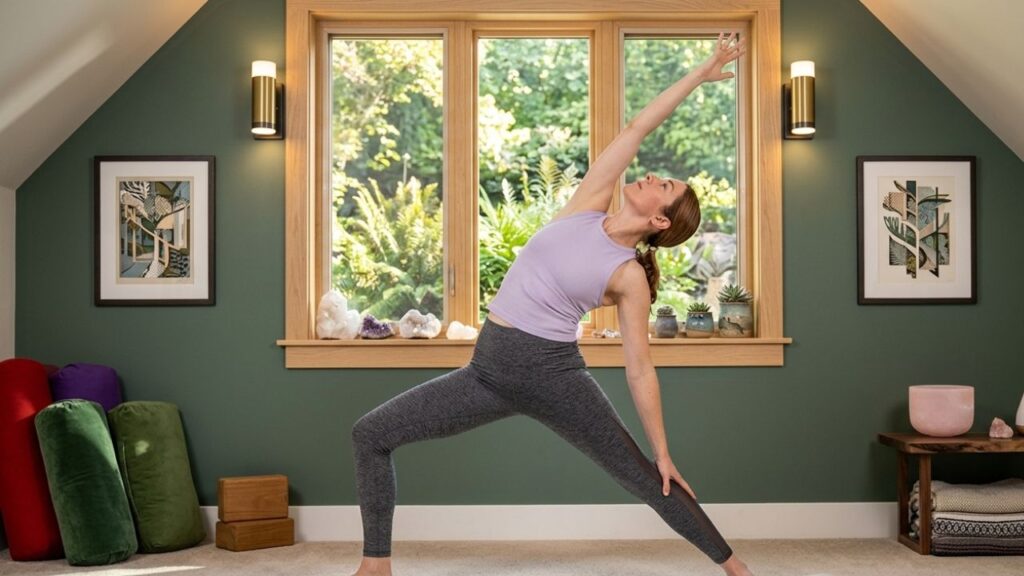
Transition into Warrior II by grounding the back foot and opening the arms wide at shoulder height. From Warrior II, move into Reverse Warrior by reaching the front arm upward while keeping the front knee bent. Then straighten the front leg and shift into Triangle Pose, lengthening through both sides of the torso.
Deep Hip Openers and Core Activation
Return to the mat and step back into Plank before lowering to Cobra and pressing again into Downward-Facing Dog.
From Downward Dog, step your foot forward for a Half Splits variation. Straighten the front leg and flex the foot while reaching the chest forward. Add a gentle twist by lifting the opposite arm toward the ceiling.
Transition into Pigeon Pose by bringing the front knee forward and extending the back leg behind you. Lift the chest for a mild backbend before folding forward if comfortable.
Next, move into Cow-Face Pose by crossing one leg over the other while seated. Wrap one arm under the other and press the forearms together to stretch the shoulders and upper back.
Finish this section with Boat Pose by balancing on your sitting bones while lifting the legs and extending the arms forward.
Closing Poses and Relaxation
After repeating the hip-opening sequence on the other side, lie down on your back and hug your knees toward your chest. Gently rock from side to side to massage the lower back.
Move into Happy Baby by holding the outer edges of the feet with knees bent and ankles stacked above the knees. Use the elbows to gently widen the knees while keeping the lower back grounded.
Release into a Reclined Twist by dropping both knees to one side while extending the arms outward in a cactus shape. Keep the shoulders relaxed on the mat and breathe deeply before switching sides.
End the practice with Savasana. Extend the legs comfortably and rest the arms beside you with palms facing upward. Close your eyes and take slow, deep breaths as the body completely relaxes. After a few minutes, gently awaken the body by moving the fingers and toes before slowly sitting up and bringing the palms together in gratitude.